

Years ago, inspecting a house for a buyer in the basement area with no concrete floor, the buyer turned to me and asked, pointing at the dirt, “What is that?” Surprised, I replied, “The earth.” I almost laughed at the time but later I reflected that this guy in his suit and tie really articulated the most profound alienation. In his aspiration to buy a piece of private property, he could not see that the house was built on the earth and that we were standing on it. It was a momentary state of mind when our powers of perception fail us. But momentary or not, it reflects the nature of the urban world we all live in. We are divorced from the earth in a thousand ways. We walk on concrete most of the time and abhor mud which we should never, never, never track into the house. The earth now passes us by in a blur as we fly down endless highways, listening to songs on the speakers surrounding us in the car.
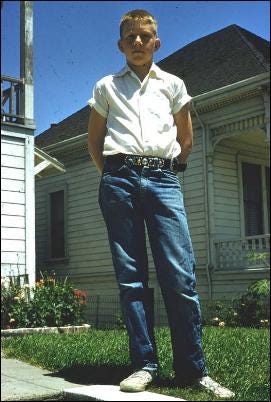
As a child growing up poor in Oakland, California, I wandered the streets wondering how I would ever find a place for myself in the world. All around me were locked doors and high fences. The only place I could wander at will was in the streets. For a while, I dreamed that I could leave the city and find a place in the country that was open and free. But there I faced private property and no trespassing signs, more fences and increasingly loud and repulsive pick up trucks, motorcycles and other machines that dominate the rural world completely. Even after a lifetime of work and change, home ownership and retirement, I still feel surprised that I found my way through the fences and locked doors. Those moments when I felt that I was a prisoner of the mean urban streets, dangerous and inhospitable, remain strong. This residue of my youth is a snapshot of the urban world’s historic legacy, a world I was born into which demands that I accept it as “reality.” Now as an old man, mad at everything and accepting nothing, I realize that the historical legacy I live in is all about private property. Salvadorean poet Roque Dalton’ words “Private Property, you have deprived me of everything” still resonate.
Millions of people all over the world, including me, have settled into a perfect system of alienation from the natural world. Wilderness is a concept on TV. National parks are the only common space left. Nature’s laws of development are only interesting to us if they serve our purposes. No matter how I oppose and despise US empire’s ways, I remain its slave. I made a living in the construction industry (where I worked for 40 years) and adapted to it. I was like a fish in water, too busy to notice the life beyond the little pond I was swimming in.
Before Private Property
As the years passed, I kept coming back to those traumatic moments in my childhood when I wandered the streets alone wishing I had a place in it. That feeling of isolation and alienation all came down to how private property ruled everything everywhere. I wondered, how did private property get to be this way? I tried to answer this question for myself in my book Private Property and the Goddess (2023). Before my years as a carpenter, I developed my historical imagination in 11 years of university level history studies. Working with my hands for decades after that brought me down from the lofty world of books and lectures into my own more immediate world where I was immersed inside private property, physically and legally and every other way. Just because I had to live inside it did not lessen my antipathy towards it. Knowing full well how immense our reliance on private property has become, I started to wonder if there ever was a time before private property existed. If so, there had to have been an initial act that created private property. The initial act did not happen in a vacuum. It happened in prehistory after millennia of human existence on this planet. It had consequences beyond imagination. But since it happened before written history, we are unaware of it and its implications for contemporary life. We are like a fish trying to understand that there is a world beyond water. And for a fish, the world beyond water means death, so it is really hard to think about.
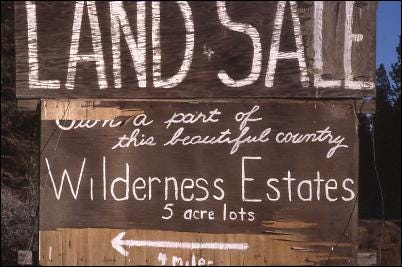
Many people cannot believe there was a time before private property. It appears to them as an immortal, irreducible tenant of all human existence, as something that is basic to “human nature.” Like water must appear to the fish. Yet consider that if there was a time before private property, it spanned many more millennia than historical time spans. According to many studies of prehistory, best summarized by Marija Gimbutas in her book Civilization of the Goddess, the human world was matrilineal and matrilocal before private property, woman centered cultures living on the land that they did not “own.” They worshiped it as the source of life, calling it Mother Earth. The act of creating private property was an act against cultures that lived in harmony with nature. Essentially, the initial act occurred when men physically occupied and took possession of some land, put up fences and separated it from the collective society around him. Privatized it. Women did not do this. Men did it. It was an act of force based on strength and violence. This first act has been immortalized in written history as the moment when God created Man. In fact it should have been labeled as the moment when God created the property owner.
Trying to imagine an act far back in time is made easier if we look at it from the standpoint of the conquest of North American continent by invading Europeans. This history has been mythologized in our stories of cowboys and Indians, stories that fascinate humanity world wide. The US genocide against millions of native people in North America was a replay of the initial act creating private property. The history books hide its true nature under the idea of “manifest destiny.” Manifest destiny embodies the notion that private property owners have the right to usurp all the lands of the earth, to conquer it, buy it or claim it for God. This is called the doctrine of discovery that originated in the Catholic church and is still today embodied in the laws that rule the western world. Private property and inheritance in the male line spread across North America with the European armies that conquered it. War and conquest are what created every empire in history. Prehistoric wars must have looked just like our 7th Calvary coming down over the hills, raiding Indian villages, killing and raping until the few survivors retreated into reservations in order to survive. Rape became a hallmark of war because it forced women out of the collective security of their women-centered cultures and villages and into captivity by the men taking over the land. Patriarchal private property originated with violence and it remains violent today. When the dust settled after conquest, property titles were handed out to the soldiers and “normal life” began. This is exactly what happened with my great great grandfather, John Baker, who fought in the Indian wars in Oregon in the 1840s and then received a partial section of land after the conquest was complete.
As private property spread in the ancient world, markets became king. Riches flowed to those who could capture wealth for themselves. The new order left the commons behind and imprisoned women and children in the monogamous family. It left the earth behind. The principles of selfishness and personal power became the driving force for both the ruling classes and for those below who sought a way out of the lower depths. Competition became the modis operandi of society replacing cooperation and collectivity that preceded it. Male privatization of property spread like a pandemic disease, multiplied and created layer upon layer of inequality, wealth and misery in society while it destroyed ancient cultures everywhere. We developed ‘haves’ and ‘have-nots.’ As nation states and imperial powers arose, history became the story of the kings and their triumphs and defeats. Today, we are watching the world’s latest empire turning into a monster that has nuclear weapons. Everyone is pointing their finger at someone else trying to understand why we are all so helpless in the face of this doomsday machine seemingly so beyond change.
The Empire Within
If we stop looking for someone to blame or some mysterious force, like God or the Devil, or Human Nature, to explain it all, but instead look inward, we have to reckon with our own blindness to the land under our feet. The existentialists saw that we all face a field of possibilities in the world that we must grapple with in finding our way. All our possibilities arise from history which makes simple thinking and common sense outmoded. Having an historical imagination is now necessary to pierce the wall of appearances in order to see the realities, or the real possibilities. Historical imagination is different than religious faith in that it references the real historical events that led up to our current reality. It requires knowledge and is not simply about the hope and faith that all of us carry around with us in one form or another.
Patriarchal private property has laid its stamp upon us in a big way. Like the other day, a neighbor walked passed me on the sidewalk in front of my house while I was looking up at the solar panels on the roof. I was so pleased, and I guess it showed, because all he had to say to me was “It will never work.” I shook my head and replied, “It is working right now.” He walked on, unmoved. The locked doors and high fences of my childhood have now become the locked minds and limited vision of people who refuse to believe what is in front of their noses. This new wall of perception is the building block upon which the illusions of the mainstream narrative is built. We are stuck in the past. Our minds have become the play toys for media moguls and their deep state bosses who manipulate us into passivity. Rebels and revolutionaries are playing against house money which has all the odds in its favor.
How strange it is to be human animals alienated from the earth. So many of us are no longer seeing the magic of the earth, the miracle of creation embodied in photo synthesis, in the sun and in the water flowing all around us. I live now in Vallejo California where many people are not aware of the fact that we live at the conjunction of two great rivers, the Napa and Sacramento rivers. This place was, and still is, sacred to the tribes who lived here for thousands of years before Europeans pushed them out. Ten years ago, in 2016, an indigenous cemetery on the river’s edge was designated as the location for a city park’s latrine until protests by local tribes and caring neighbors stopped it. No monuments were erected, however. The place is now covered in lawn.
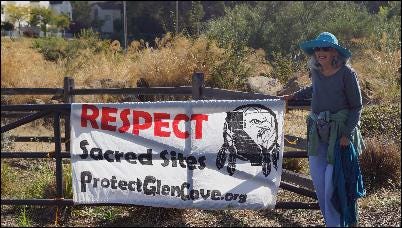
How can we live in harmony with nature when we do not see it? We have to see it first in order to begin to live in harmony with it. How can we see it when our nameless creeks run under our feet in culverts or in unruly ditches on the side of the road?
We are frozen inside a monster propelling us willy nilly towards the proverbial cliff. We won’t solve this problem through reforming the tools of patriarchy that have gotten us here. The master is incapable of ending slavery. Only the slaves can do that. Letting go of the reigns of patriarchal power is more than fighting for the equality of women. It is letting go of our belief that we humans have the right to do harm to the earth whenever it suits our purpose, whether it be for our convenience, for profit or even for the common good.